So you’ve pulled your Google Ads report and your campaign is sitting at a 2% CTR. Maybe that feels decent. Maybe you’re not sure. The honest answer is: it depends on more variables than most people expect, and the number by itself doesn’t tell you much without context.
Here’s what the actual data says, and more importantly, how to interpret it for your specific situation.
What a 2% CTR Means in Plain Terms
CTR (click-through rate) measures how often people click your ad after seeing it. A 2% CTR means that out of every 100 times your ad was shown, two people clicked it.
The formula is simple:
CTR = (Total Clicks ÷ Total Impressions) × 100
If your ad received 200 clicks from 10,000 impressions, your CTR is 2%. You can verify this anytime using the CTR calculator on QuickMarketingTools.
What the formula doesn’t tell you is whether 2% is competitive, underperforming, or surprisingly strong for your context. That’s where benchmarks and campaign type come in.
The Short Answer: It Depends on Campaign Type
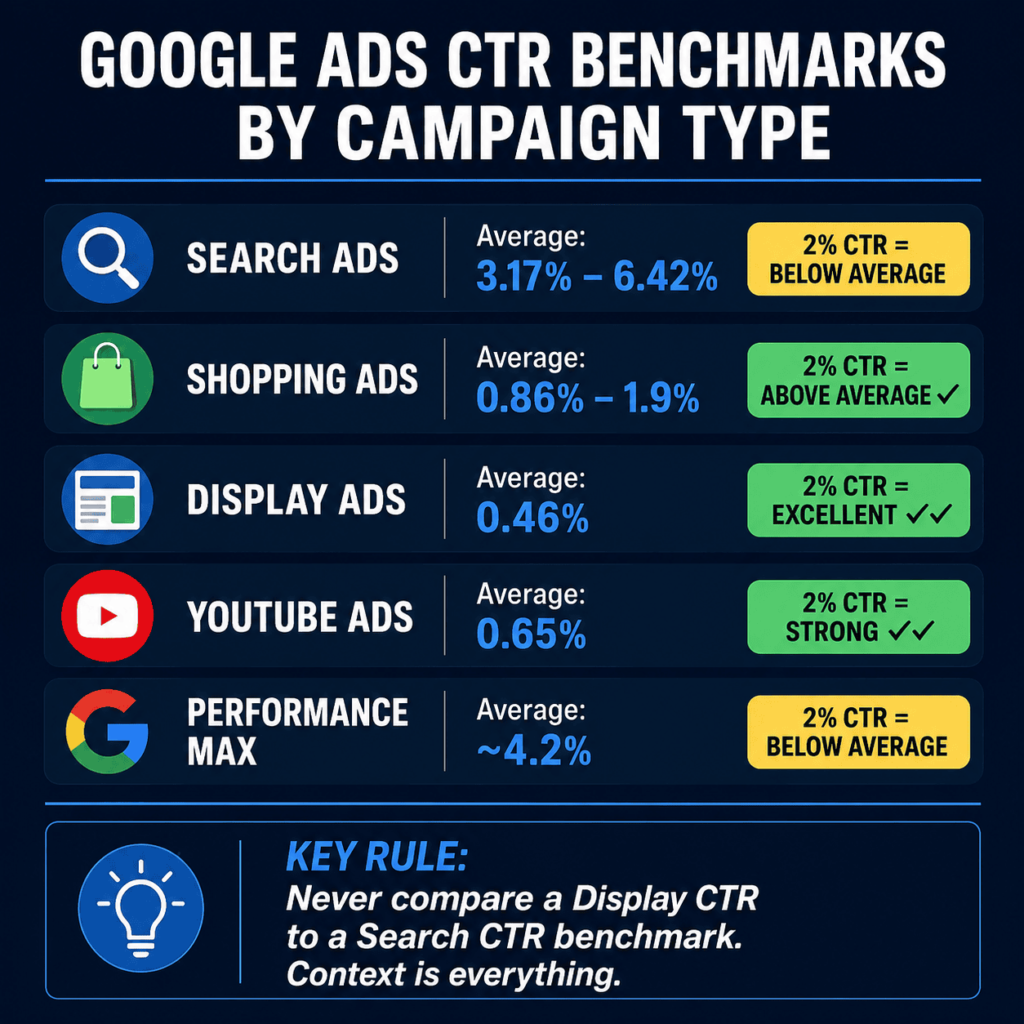
This is genuinely the most important factor. Google Ads encompasses several very different campaign types, and a 2% CTR lands differently in each one.
| Campaign Type | Industry Average CTR | How 2% Compares |
| Search Ads | ~3.17% – 6.42% | Below average to average |
| Shopping Ads | ~0.86% – 1.9% | Above average |
| Display Ads | ~0.46% | Excellent |
| YouTube Ads | ~0.65% | Strong |
| Performance Max | ~4.2% | Below average |
If you’re running Search campaigns, a 2% CTR is below the current cross-industry average. It’s not a crisis, but it’s a sign there may be room to tighten things up.
If you’re running Shopping campaigns for an ecommerce store, 2% is actually competitive -most advertisers land between 0.86% and 1.9% in this format, so reaching 2% puts you ahead of the average.
If you’re running Display campaigns, a 2% CTR is genuinely excellent. The average is around 0.46%, meaning you’d be performing more than four times better than most advertisers.
This distinction alone changes the entire conversation. Comparing a Display CTR to a Search CTR benchmark is a mistake a lot of newer advertisers make.
What Google Ads Search Benchmarks Look Like Right Now
For Search campaigns specifically -which is what most advertisers are referring to when they ask about CTR -the numbers have actually shifted upward in recent years.
According to WordStream’s 2024 benchmark data, the average CTR across all Google Ads search campaigns was 6.42%, with Arts and Entertainment leading at 13.04%, Sports and Recreation at 9.66%, and Real Estate at 9.20%.
Those numbers are considerably higher than the older 3-4% benchmarks many guides still quote, partly because of how Google has changed the search results page. The SERP has become more ad-friendly, with more results above the fold occupied by ads that blend into organic results. When ads look more like organic results, people click them more often -which pushes averages up across the board.
That said, not every industry sees those high rates. Attorneys and Legal Services averaged 5.30%, Dentists and Dental Services 5.38%, and Home and Home Improvement 5.59% -the lowest of the industries tracked.
So against a 6.42% industry-wide average, a 2% search CTR is below where most campaigns should aim. But that doesn’t mean panic -it means there’s a clear optimization target.
When a 2% Search CTR Is Actually Fine
There are real scenarios where 2% is a reasonable or even expected outcome:
B2B and enterprise keywords -Long-tail, high-intent B2B keywords often carry lower CTRs. Someone searching “enterprise HR software vendor comparison” isn’t clicking ads casually. The buying cycle is long, the searcher is cautious, and clicks tend to be fewer but more deliberate. A 2% CTR might be considered stellar for B2B SaaS.
Branded competitor terms -Bidding on competitor brand names typically produces lower CTRs because a large portion of those searchers specifically want the competitor, not you. The click rate will naturally lag.
High-competition legal or financial keywords -These spaces see lower average CTRs because the CPC is high, ad positions are contested, and users often research before clicking. Industries like legal and insurance with low CTRs also tend to have the highest CPCs -because low CTR depresses Quality Score and pushes bids up.
New campaigns with limited data -A fresh campaign often shows lower CTR while Google is still learning which searches to match it to and which audiences are most likely to click. This often improves over time without any copy changes at all.
Broad match keyword campaigns -If you’re using broad match aggressively, your ads are showing up for tangentially related queries where click intent is lower. The CTR reflects that broader, lower-intent exposure.
When a 2% Search CTR Is a Warning Sign
On the other hand, there are situations where a 2% search CTR deserves attention:
Non-branded, high-intent keywords -If you’re bidding on transactional keywords like “buy running shoes online” or “plumber in [city]” and you’re only seeing 2% CTR, something is off. These searches represent strong intent, and a well-written ad with relevant extensions should be doing better.
Top ad position with low CTR -Ad position and CTR are closely linked. Ads appearing in position one typically outperform lower positions. If you’re in the top position and still seeing 2% CTR, the ad copy itself likely needs work.
Compared to past performance -If your campaign used to run at 4-5% CTR and has dropped to 2%, that regression is worth investigating. Competitor activity, ad fatigue, match type drift, or copy deterioration could all be contributing.
Generic, broad keywords -“Marketing software” or “business insurance” are examples where user intent is scattered. You’ll get impressions, but you’ll also attract a lot of people who weren’t looking for exactly what you offer -and that keeps CTR low.
How CTR Connects to Quality Score (and Why It Matters)
CTR isn’t just a performance metric -it feeds directly into Google’s Quality Score, which affects both your ad position and what you pay per click.
Expected CTR is one of three components in Google’s Quality Score system, alongside ad relevance and landing page experience. Google predicts how likely users are to click your ad, and a higher expected CTR helps your ad achieve better positioning with lower bids.
Each 1-point increase in Quality Score can reduce your CPC by 13-16% while maintaining or improving ad position. This is where a sustained low CTR starts costing you money beyond just fewer clicks -you end up paying more per click than advertisers with better-performing ads.
A large number of low Quality Score keywords with poor historical CTR can drag down the overall account, making it harder for new keywords to perform well from the start.
Real-World Example: Same CTR, Very Different Situations
Consider two advertisers both reporting a 2% CTR.
Advertiser A runs a B2B software company bidding on terms like “procurement automation software for enterprises.” The average deal value is $40,000. They get 80 clicks a month at $12 per click -spending $960. They convert 5% of those clicks to demo requests, generating 4 qualified demos. One of those closes. That’s a $40,000 deal from $960 in spend. For this advertiser, a 2% CTR is completely fine. The CPA is strong, the ROAS is extraordinary, and nobody is worried about the CTR number.
Advertiser B runs a consumer ecommerce store selling $35 phone cases, bidding on “buy phone case” and similar transactional terms. At 2% CTR, they’re getting fewer clicks than competitors who are converting the same search intent more effectively. Each competitor click they lose is a potential sale gone. Here, improving CTR from 2% to 5% could meaningfully change revenue -not just the CTR metric.
Same number. Completely different implication. This is why the right question isn’t “is 2% good?” but “is 2% costing me anything, and can I do better?”
Practical Ways to Improve CTR from 2%
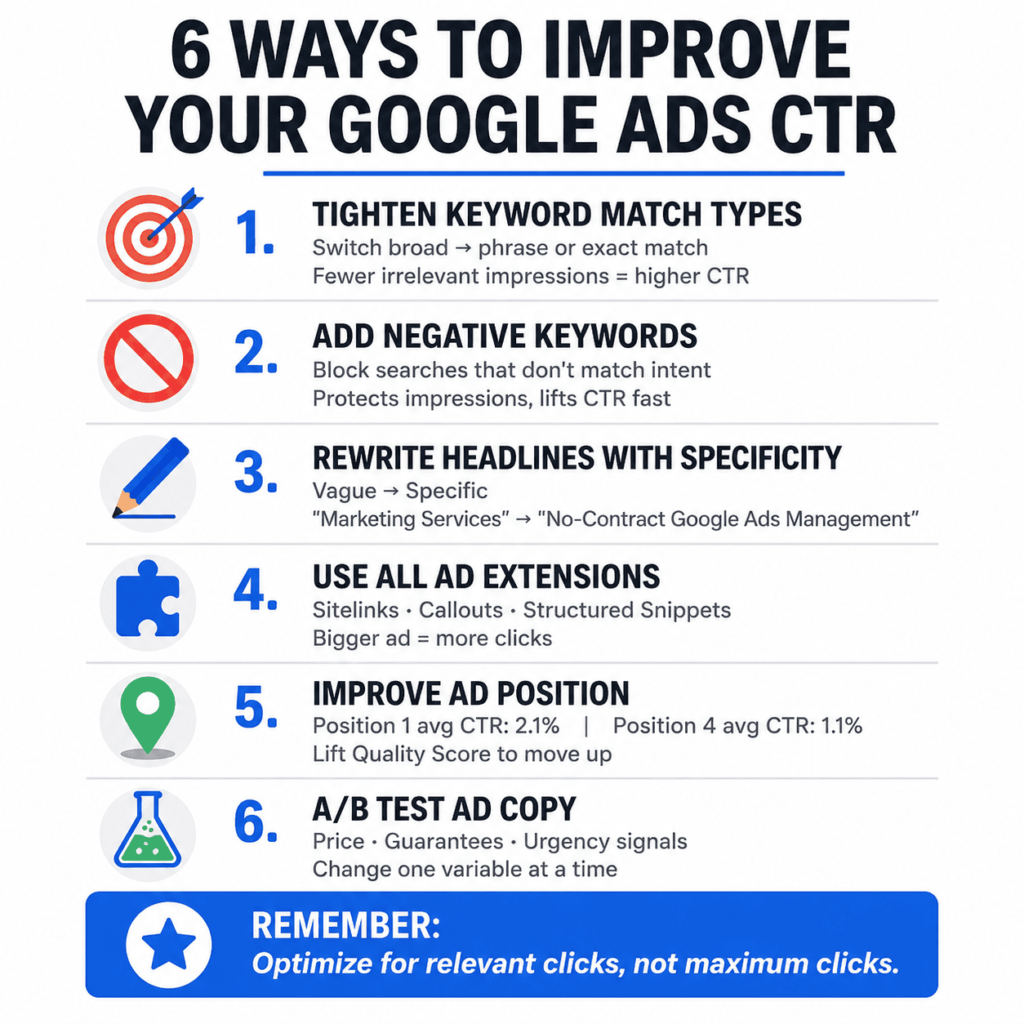
If you’ve determined that 2% is below where your campaign should be, here are the levers worth testing first.
Tighten keyword match types. Broad match pulls in a wide range of queries, many of which don’t match user intent well enough to generate clicks. Switching to phrase or exact match for your core terms often brings an immediate CTR lift because impressions drop faster than clicks.
Add meaningful negative keywords. If your ad is showing for searches that aren’t relevant, those impressions count against your CTR without contributing clicks. Building a solid negative keyword list is one of the highest-ROI optimizations in Google Ads.
Rewrite ad headlines with stronger specificity. Vague headlines like “Quality Marketing Services” underperform compared to specific ones like “Google Ads Management – No Long-Term Contracts.” The more your headline matches what the searcher is actually looking for, the higher the CTR. If you want to test headline variations at scale, the CTR Improver tool can help generate alternative framings worth testing.
Use all available ad extensions. Sitelinks, callouts, structured snippets, call extensions, and location extensions all make your ad physically larger and more prominent on the page. A larger ad with more relevant information naturally attracts more clicks.
Check your ad position. An ad in the top position of a SERP averages a 2.1% CTR, while an ad in position four averages 1.1%. If your average position is low, improving Quality Score or bid strategy can move you up and lift CTR without changing a word of copy.
Test emotional and value-based copy variations. Price advantages, guarantees, unique features, and urgency signals (like limited-time offers) all influence whether someone clicks. A/B testing copy isn’t glamorous, but it’s where real CTR improvement happens over time.
What a Good CTR Actually Looks Like by Industry
Rather than chasing a single universal benchmark, it’s more useful to know what your industry peers are seeing. Based on current data:
- Arts and Entertainment: 13%+
- Sports and Recreation: 9-10%
- Real Estate: 8-9%
- Travel: 7-8%
- Finance and Insurance: 5-6%
- Health and Medical: 5-6%
- B2B / Technology: 2-5%
- Legal Services: 5-6% (high CPC, competitive)
- Home Improvement: 5-6%
If your industry benchmark is 5-6% and you’re at 2%, there’s a meaningful gap worth closing. If your benchmark is 3-4% and you’re at 2%, it’s a smaller gap -still worth addressing, but not urgent.
The most relevant comparison is always your own historical data and your direct competitors. Industry averages from third-party reports are a starting point, not a verdict.
CTR Is Only One Part of the Performance Picture
This is probably the most important thing to internalize: CTR only measures the top of the funnel. It tells you whether your ad is compelling enough to earn a click. It doesn’t tell you whether those clicks become leads, sales, or revenue.
A high CTR is a good sign, but it needs to be paired with strong conversion performance to translate into real value.
It’s entirely possible to have a 10% CTR and lose money on every campaign if the conversion rate is terrible and the ad attracts the wrong audience. It’s also possible to run a 2% CTR campaign that’s quietly one of the most profitable things in your account, because the clicks that do come through are highly qualified.
When evaluating CTR, always look at it alongside:
- Conversion rate – what percentage of clicks complete the desired action
- Cost per acquisition (CPA) – what you’re actually paying per lead or sale (CPA calculator)
- ROAS – the revenue generated per dollar spent on ads (ROAS calculator)
A campaign where CTR is 2% but CPA is $8 and you’re selling a $500 product deserves celebration, not optimization. A campaign with 8% CTR and a $400 CPA on a $300 product needs attention regardless of how good the CTR looks.
The 2% CTR Question, Answered Directly
To give a direct answer by scenario:
- Search campaign, most industries: 2% is below average and worth improving, though not alarming
- Search campaign, B2B or high-ticket: 2% may be acceptable depending on conversion quality
- Shopping campaign: 2% is above average -good performance
- Display campaign: 2% is excellent -well above the 0.46% norm
- YouTube campaign: 2% is strong -the average is around 0.65%
If you’re unsure how your CTR stacks up against your specific cost structure, running the numbers through a ROAS calculator or ROI calculator will tell you more about actual campaign health than the CTR number alone.
A Few Things Worth Knowing Before You Optimize
One thing that gets overlooked: optimizing purely for higher CTR can actually hurt performance if you’re not careful. Clickbait-style headlines that promise something your landing page doesn’t deliver will spike CTR and tank conversion rate. You end up paying for more clicks that don’t convert, which means higher CPAs and worse ROAS.
The goal is relevant clicks, not maximum clicks. A 4% CTR from highly qualified searchers beats an 8% CTR from people who click out of curiosity and immediately leave.
Also worth noting – if you’re running Performance Max campaigns, CTR benchmarks work differently because the format blends search, display, shopping, and video placements. A blended CTR from a PMax campaign needs to be interpreted differently than a pure Search campaign CTR.
And if you’re just starting out and want to benchmark performance across all your marketing channels -not just Google Ads -the full suite of marketing and advertising calculators can help you build a clearer picture of where each channel stands.
Summary
A 2% CTR in Google Ads is:
- Below average for most Search campaigns (where the cross-industry average is 3-6%)
- Competitive for Shopping campaigns
- Excellent for Display campaigns
- Acceptable for B2B Search campaigns with strong downstream conversion metrics
The number itself means less than the context around it. What campaign type? What industry? What’s the conversion rate and CPA? Is it trending up or down? Those answers matter far more than whether 2% sounds high or low in isolation.
If you want to improve it, start with keyword match types and negative keywords before rewriting the copy. And if you do rewrite a copy, test methodically -change one variable at a time so you know what’s actually working.
Sources and methodology
The CTR examples in this article use Google Ads search/display concepts and public benchmark reports as comparison context. They are not pass/fail thresholds. A 2% CTR can be weak, normal, or acceptable depending on campaign type, network, industry, keyword intent, match type, ad position, geography, and conversion quality.