Search intent is the single biggest reason two pages targeting “similar” keywords can perform completely differently in Google. A page built for someone comparing options gets buried when the searcher actually wants to buy something right now – and vice versa. Understanding the split between informational and transactional keywords is what separates content that ranks and converts from content that just sits there collecting impressions with a 0.4% CTR.
This guide breaks down what actually separates these two keyword types, how to spot them in the wild, and how to build a keyword strategy around them instead of guessing.
Quick Answer
Informational keywords are searches where the user wants to learn something – “what is,” “how does,” “guide to.” Transactional keywords are searches where the user wants to do something – buy, sign up, book, download, or compare with intent to purchase. The words themselves are the biggest clue, but so is the SERP: informational queries return articles and guides, transactional queries return product pages, category pages, and ads.
Mixing these up in your content strategy is one of the fastest ways to write a page that ranks for the wrong reason, or doesn’t rank at all because Google can tell your content type doesn’t match what searchers expect.
What Search Intent Actually Means
Every query typed into Google carries a job to be done. Google’s own Search Quality Rater Guidelines (the document Google gives to human evaluators who assess search results) breaks intent into four broad categories: Know, Do, Website, and Visit-in-person. Marketers usually simplify this into four working buckets:
- Informational – the person wants to know something
- Navigational – the person wants to go somewhere specific (a brand, a login page)
- Commercial investigation – the person is comparing options before buying
- Transactional – the person wants to complete an action, usually a purchase
Informational and transactional sit at opposite ends of the funnel, which is why they get compared so often. Commercial investigation is really the bridge between them, and a lot of confusion in keyword research happens because people try to force a commercial-investigation keyword into one of the other two buckets.
Informational Keywords: What They Look Like
Informational keywords are searches driven by curiosity or a need to understand something before making a decision. The person isn’t ready to buy – they’re still figuring out what the problem even is.
Common patterns:
- What is [term]
- How does [process] work
- Why is [problem] happening
- [Topic] guide
- [Term] vs [term] (when it’s conceptual, not product-based)
- Examples of [thing]
Real examples:
- “what is CTR in Google Ads”
- “how does ROAS get calculated”
- “why is my bounce rate so high”
- “informational vs transactional keywords” (the query behind this very article, incidentally)
If you’re mapping this to a business, someone Googling “how does compound interest work” isn’t in the mood to open a savings account that afternoon. They’re building understanding. Content built for these queries should teach, not sell. A hard pitch dropped into an informational article tends to hurt engagement metrics rather than help conversions, because it interrupts the thing the reader actually came for.
Google generally rewards long-form, well-structured explainer content for these terms – think comprehensive guides, definitions with context, and pages that answer the follow-up questions before the reader has to ask them. Our own posts on what a good bounce rate looks like and average CTR by industry are built exactly this way – they answer the “what is normal” question directly, then go deeper.
Transactional Keywords: What They Look Like
Transactional keywords carry action intent. The searcher already knows roughly what they want; they’re looking for the fastest path to get it.
Common patterns:
- Buy [product]
- [Tool/service] free
- [Product] pricing
- Sign up for [service]
- [Tool] calculator
- Discount code for [brand]
- Near me (for local transactional queries)
Real examples:
- “CTR calculator free”
- “buy running shoes size 10”
- “invoice generator online”
- “QR code generator for marketing”
A search like “CPA calculator” is transactional even though there’s no product being purchased – the person wants to complete a task immediately, and that’s the defining trait of transactional intent, not just “commerce.” This is a distinction a lot of keyword tools get wrong by treating “transactional” as synonymous with “ecommerce.” It isn’t. Anyone searching for our CTR calculator or UTM builder has transactional intent even though no money changes hands.
Pages built for transactional keywords should get the person to the action fast. Long preambles, extended definitions, and history lessons before the “buy” button work against you here. This is one of the reasons tool pages tend to outperform blog posts for these queries – the format itself matches intent.
Side-by-Side Comparison
| Informational | Transactional | |
| Searcher’s goal | Learn or understand | Complete an action |
| Funnel stage | Top of funnel (TOFU) | Bottom of funnel (BOFU) |
| Typical SERP result | Blog posts, guides, Wikipedia, forums | Product pages, tools, landing pages, ads |
| Content format that ranks | Long-form explainers, how-tos | Concise, action-first pages |
| Common modifiers | what, why, how, guide, examples | buy, price, near me, free, calculator, sign up |
| Monetization approach | Ads, affiliate mentions, lead magnets | Direct conversion, checkout, signup form |
| Typical CTR on paid ads | Lower (browsing behavior) | Higher when ad copy matches intent |
| Ideal page type | Blog article, resource hub | Product page, tool, pricing page |
Where People Get This Wrong
A mistake we see constantly in keyword research spreadsheets: treating every “vs” keyword as commercial investigation, and every keyword with a number in it as transactional. Neither assumption holds up.
“CTR vs CPC” is informational – people want to understand the conceptual difference, not buy a CTR. Compare that with “iPhone 15 vs iPhone 14 pricing,” which leans transactional because pricing is baked into the query. Context around the modifier matters more than the modifier alone.
Another common error is writing a 2,500-word guide for a keyword that Google’s SERP is clearly answering with tools and calculators. If you search “CPA calculator” right now, you’ll see calculator widgets and tool pages dominating page one, not articles. Writing a long-form article for that keyword and expecting it to outrank the tools is fighting the SERP instead of reading it. This is exactly why we built a dedicated keyword intent checker – running a keyword through it before committing to a content format saves a lot of wasted writing time.
How to Identify Intent Before You Write
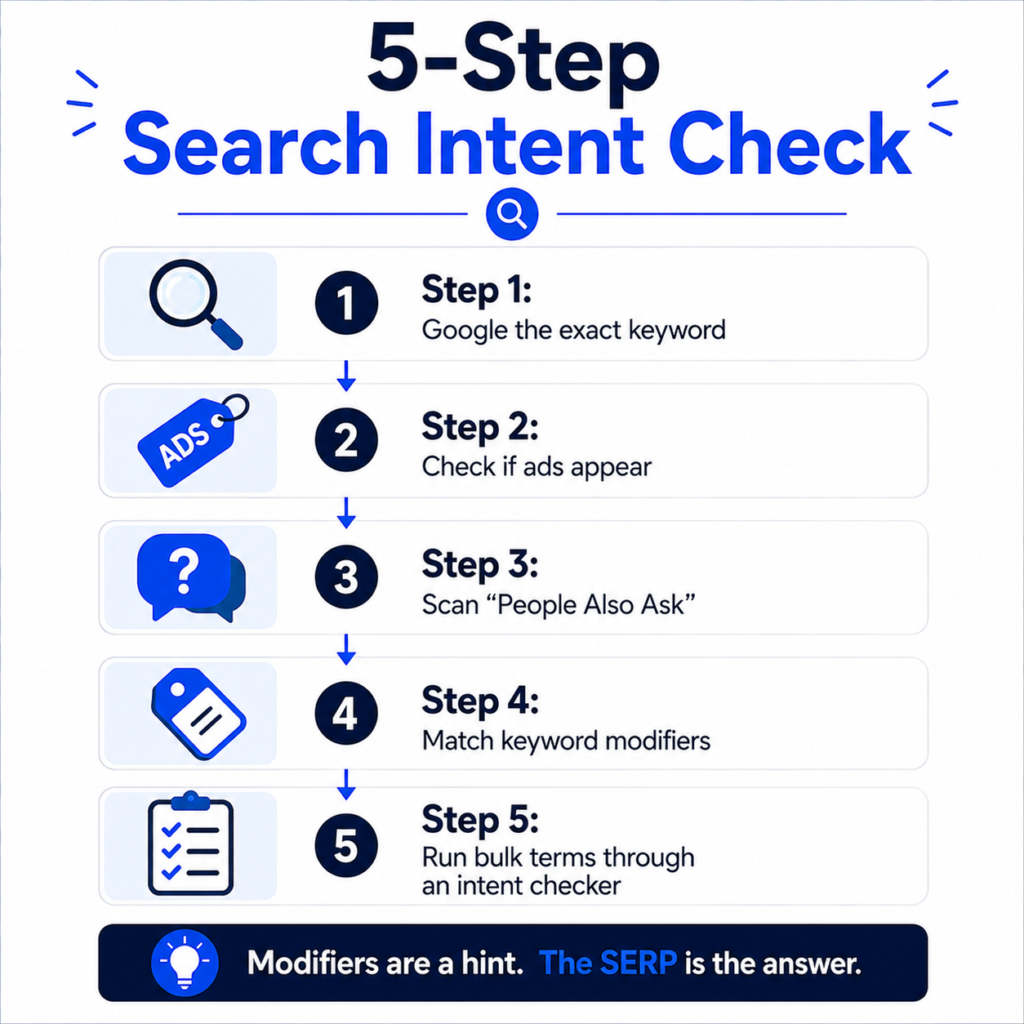
A practical, five-minute process that works better than guessing from the keyword alone:
- Google the exact keyword and look at what’s actually ranking – articles, tools, product listings, or a mix
- Check for ads. Google doesn’t run ads on purely informational queries very often, because advertisers know those searchers aren’t ready to buy. Ads present usually signal at least some transactional or commercial intent
- Look at the “People also ask” box. Informational follow-ups signal informational intent; comparison and pricing follow-ups signal commercial or transactional intent
- Check keyword modifiers against the patterns above, but don’t stop there – modifiers are a starting hypothesis, not a verdict
- Run it through an intent classifier if you’re processing keywords in bulk, since manually checking hundreds of SERPs isn’t realistic for most content calendars
For agencies or in-house teams building out large keyword lists, doing this manually for every term doesn’t scale. This is really a bulk-processing problem, and it’s worth automating the classification step before assigning content briefs.
A Practical Scenario: SaaS Content Planning
Say a small SaaS company selling email marketing software is building a content calendar. Their keyword list includes:
- “what is email open rate” – informational
- “email open rate benchmarks by industry” – informational, borderline commercial
- “best email marketing software” – commercial investigation
- “Mailchimp alternative pricing” – transactional
- “email marketing software free trial” – transactional
A team that treats all five the same way – say, writing a 1,500-word blog post for each – is going to underperform on the last two. “Email marketing software free trial” doesn’t need 1,500 words. It needs a landing page with a clear CTA above the fold, pricing transparency, and minimal friction. Meanwhile “what is email open rate” genuinely benefits from a thorough explainer, because that’s what searchers and Google both expect.
The content calendar mistake isn’t a lack of keywords – it’s applying one format to every intent type on the list.
Why This Matters for SEO and PPC Together
If you’re running Google Ads and organic SEO side by side, mismatched intent creates two separate but related problems.
In PPC, bidding on informational keywords for a hard-sell ad usually produces a low Quality Score and a poor CTR, because your ad copy doesn’t match what the searcher wants. Google’s ad rank formula partly depends on expected clickthrough rate, and mismatched intent tanks that. Our post on why CTR might be lower than expected covers this exact failure mode in more depth.
In SEO, targeting a transactional keyword with an informational page (or the reverse) means fighting Google’s own understanding of what that query deserves. You can have perfect on-page SEO and still not rank, simply because the content format is wrong for the intent Google has already determined the query carries.
Common Mistakes to Avoid
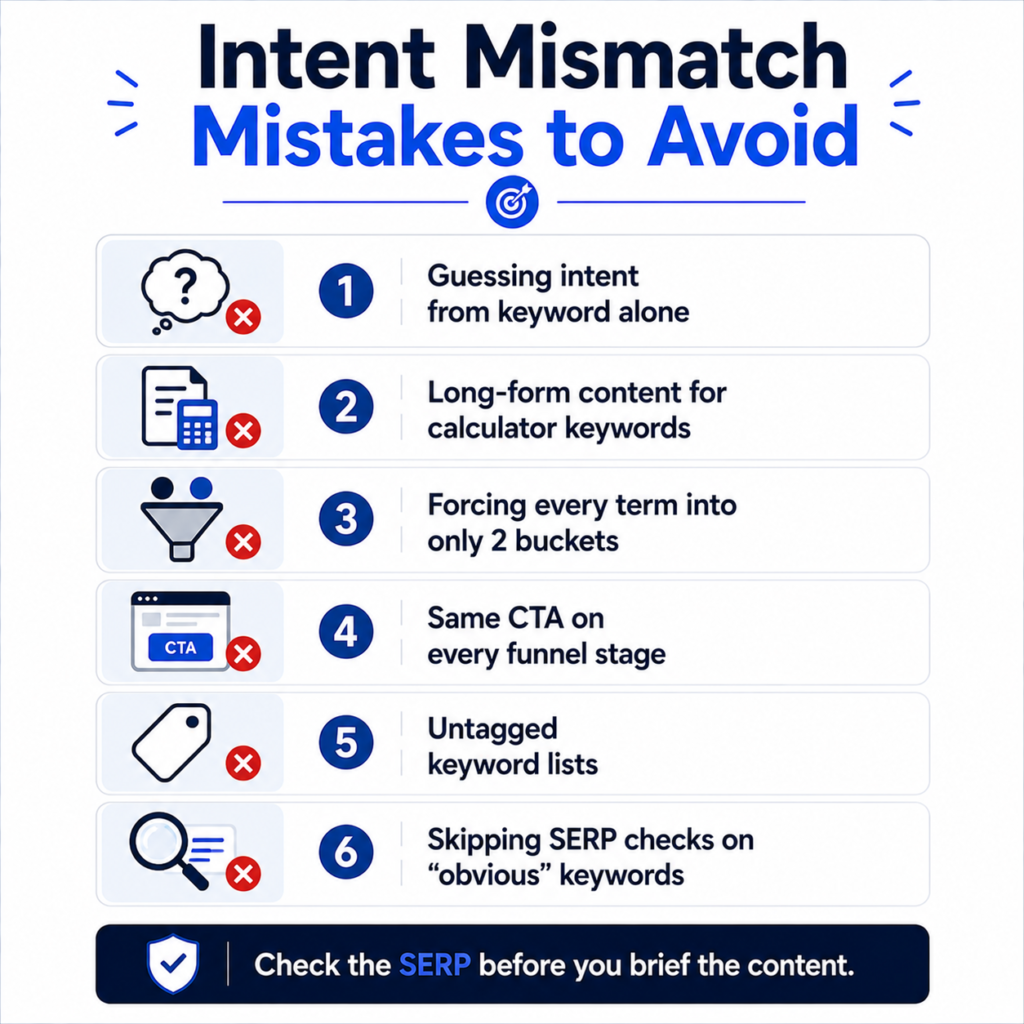
- Assuming intent from the keyword alone without checking the actual SERP
- Writing long-form content for calculator or tool-style keywords, when a functional tool would perform better
- Ignoring commercial investigation as its own category, forcing keywords into either informational or transactional buckets when they’re really somewhere in between
- Using the same call-to-action across every page type regardless of funnel stage
- Building keyword lists without tagging intent, which makes content planning reactive instead of strategic
- Skipping intent research for “obvious” keywords – assumptions about what a keyword means are wrong more often than most marketers expect
Tools That Help With This
Classifying intent by hand across a large keyword list is slow and inconsistent between team members. A few tools make the process more reliable:
- The keyword intent checker gives a fast read on how a keyword is likely to be interpreted, which is useful before assigning a content brief
- The SERP snippet preview tool helps you see how your title and meta description will actually display, which matters more for transactional pages where every character of the snippet needs to earn the click
- The keyword density checker is worth a look once the content is drafted, to make sure the primary and secondary keywords appear naturally without stuffing
- For transactional pages tied to paid campaigns, the UTM builder keeps campaign tracking consistent across channels
None of these replace judgment – they speed up a process that otherwise depends entirely on manually checking SERPs one keyword at a time.
Understanding where a keyword sits on the informational-to-transactional spectrum isn’t an academic exercise – it directly decides whether your content ranks, whether it converts, and whether the time spent writing it was worth it. Check the SERP, tag your keyword list by intent before you brief any content, and build the page format the searcher is actually expecting. For more on turning keyword research into a working content strategy, browse the rest of the blog or explore the full SEO tools collection.
Frequently Asked Questions
Is “best” always a commercial investigation keyword?
Usually, but not always. “Best marketing tools for agencies” is commercial investigation. “Best way to explain search intent to a client” is informational, even though it contains the word “best.”
Can one keyword have both informational and transactional intent?
Yes, and Google sometimes shows a mixed SERP for exactly this reason – a definition box alongside product listings. When you see a mixed SERP, a hybrid page (a solid explainer that transitions into a clear next step) tends to perform better than a page that leans hard into just one side.
Should informational content ever include a call-to-action?
Yes, but it should be soft and secondary – a natural next step, not the focus of the page. Someone reading “what is ROAS” might reasonably want to try a ROAS calculator afterward, but the CTA shouldn’t interrupt the explanation itself.
Does keyword intent change over time?
It can. A keyword that was purely informational a few years ago can pick up transactional intent as more tools and products get built around it. Checking current SERPs periodically is worth doing for high-value keywords rather than assuming intent is fixed forever.