Most content plans fall apart for one simple reason: someone tries to make a single piece of content do two jobs at once. A blog post that’s supposed to build brand awareness also tries to sell a product in paragraph three. A landing page written for someone ready to buy opens with a broad industry definition nobody asked for. The reader feels the mismatch even if they can’t name it, and they leave.
Understanding the difference between top-funnel and bottom-funnel content helps fix that problem. It’s not just a theoretical marketing concept; it affects whether a page matches the reader’s stage of awareness, research, or buying intent.
This guide breaks down what separates the two, when to use each, how to measure them properly, and how to build a more balanced content mix.
What Top-Funnel and Bottom-Funnel Content Actually Mean
The “funnel” is just a way of describing where someone stands in their decision-making process, from complete stranger to paying customer. Marketers usually split it into three stages: top (awareness), middle (consideration), and bottom (decision).
Top-funnel content targets people who have a problem but don’t necessarily know your brand, your product, or sometimes even the exact solution category they need. They’re searching things like “why is my website traffic dropping” or “how to reduce customer churn.” They’re not ready to buy anything. They’re trying to understand a situation.
Bottom-funnel content targets people who already understand their problem and are actively comparing solutions or vendors. Their searches look like “QuickMarketingTools vs [competitor],” “best CTR calculator for PPC agencies,” or “[product name] pricing.” They’re close to a decision and often just need reassurance or a final push.
The confusion happens in the middle. A lot of content that gets labeled “top-funnel” is actually written with bottom-funnel intent (product mentions, CTAs to buy, feature comparisons buried in an “educational” post), and it underperforms because of it.
Why the Distinction Actually Matters
Here’s the practical issue: search intent and buyer intent are not evenly matched across every keyword. Someone searching a broad, informational term is not in the same headspace as someone searching a branded or transactional term. This is closely related to the difference laid out in our guide on informational vs transactional keywords – the funnel stage a piece of content targets should match the intent behind the keyword and the reader’s likely next step.
Get this wrong and you get two common failures:
- Top-funnel content that’s too salesy. It ranks for the awareness-stage keyword, but the reader bounces because the article tries to sell them something before earning trust. Bounce rate climbs, and if you’re unsure what a concerning bounce rate looks like for your content type, it’s worth checking our breakdown of what counts as a good bounce rate.
- Bottom-funnel content that’s too vague. A pricing page or comparison page that talks in generalities instead of giving a straight answer loses the conversion it was one click away from getting.
Content that matches funnel stage to intent tends to perform better on both engagement metrics and conversion metrics, because it’s answering the actual question the reader has, not the question a content calendar assumed they’d have.
Top-Funnel Content: What It Looks Like and What It’s For
Top-funnel content exists to attract attention, build trust, and get found. Its job is not to sell. If it sells, it usually sells worse, because the reader isn’t there yet.
Goals of top-funnel content:
- Attract organic traffic on broad, high-volume, informational keywords
- Build topical coverage and demonstrate practical expertise
- Build brand recall for later stages
- Capture attention on social platforms and in search
- Generate email subscribers or light-touch leads
Common formats:
- “What is X” and “Why does X happen” articles
- Industry trend roundups and data-driven reports
- How-to guides for general problems (not product-specific)
- Glossaries and definitions
- Beginner checklists and frameworks
- Social media content aimed at reach rather than clicks
Example scenario – SaaS company: A project management SaaS publishes “Why Remote Teams Miss Deadlines” for operations managers who may not know the product yet. The page should not be judged like a pricing page. Its job is to explain the problem clearly, introduce useful ways to think about it, and offer a sensible next step for readers who want to go deeper.
Top-funnel content should almost never hard-sell. A soft mention of a relevant free tool, positioned as genuinely useful rather than promotional, is usually the ceiling. For instance, an article about tracking campaign performance might mention the marketing KPI dashboard in passing, not as a call to action.
Bottom-Funnel Content: What It Looks Like and What It’s For
Bottom-funnel content exists to convert. The reader already knows they have a problem and is deciding between doing nothing, doing it themselves, or picking a specific vendor.
Goals of bottom-funnel content:
- Convert warm traffic into leads, trials, or sales
- Answer objections directly (price, features, comparisons)
- Provide proof (case studies, reviews, data)
- Remove friction from the final decision
Common formats:
- Product and service pages
- Pricing pages
- Comparison pages (“X vs Y”)
- Case studies and testimonials
- Free trial or demo pages
- Calculators and interactive tools that lead directly to a product
Example scenario – Ecommerce store: A DTC skincare brand runs a page titled “Retinol vs Retinol Alternative: Which Is Right for Sensitive Skin?” It may get less traffic than a broad educational post, but visitors are actively comparing two specific options before buying. Lower volume and higher intent is a normal bottom-funnel pattern, but the actual conversion rate depends on the offer, pricing, audience, and page quality.
Bottom-funnel content should be direct. Vague language, hedging, and generic advice all work against it. If a reader is comparing return on ad spend across channels before committing budget, a page that walks them through the actual math using something like the ROAS calculator does more conversion work than a paragraph explaining what ROAS is in the abstract.
Top Funnel vs Bottom Funnel Content: Side-by-Side Comparison
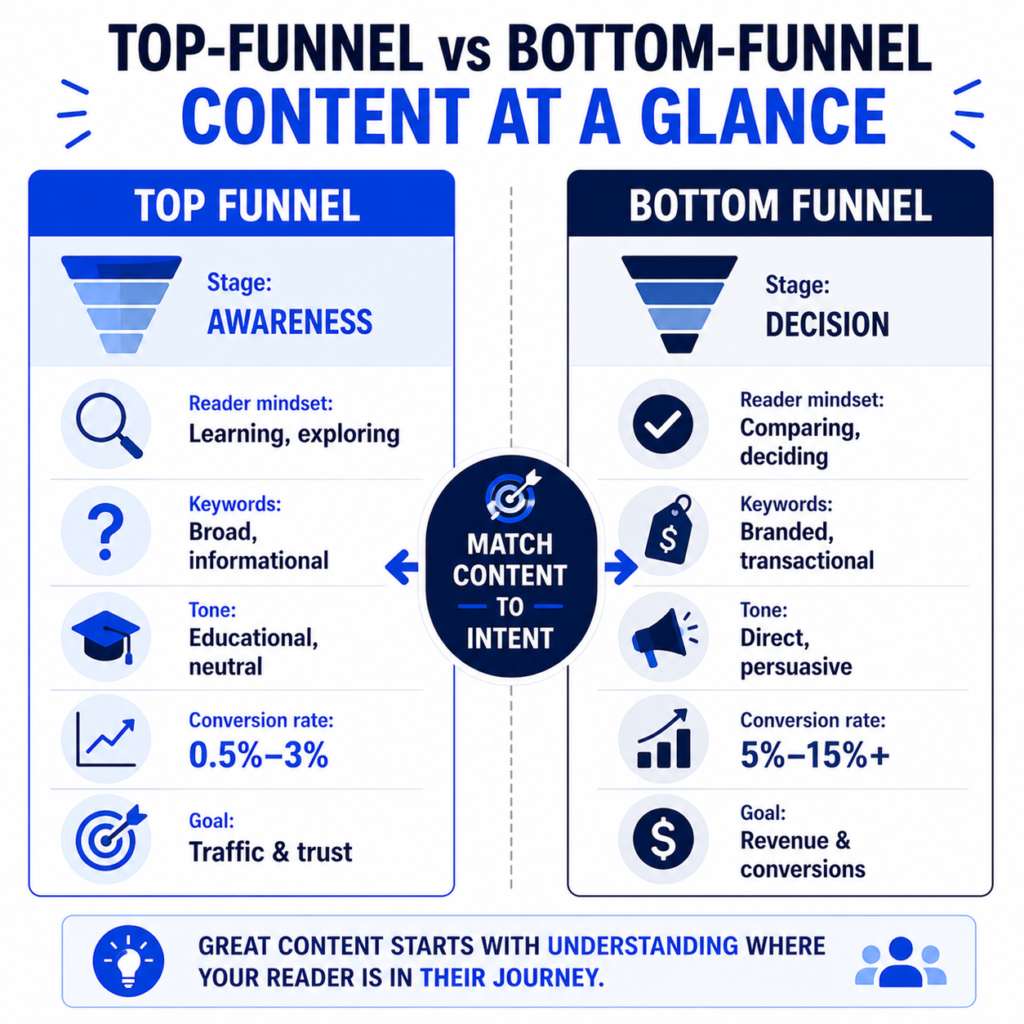
| Factor | Top-Funnel Content | Bottom-Funnel Content |
| Reader intent | Learning, exploring | Comparing, deciding |
| Search volume | Usually high | Usually low to moderate |
| Conversion rate | Low (0.5%-3% typical) | High (5%-15%+ typical) |
| Tone | Educational, neutral | Direct, persuasive |
| Product mentions | Minimal, soft | Central, explicit |
| Content examples | Guides, definitions, trends | Comparisons, case studies, pricing |
| Primary metric | Traffic, engagement, backlinks | Conversion rate, revenue, CAC |
| Time to see ROI | Months | Weeks |
| SEO competition | Often high | Often lower, more niche |
Neither column is “better.” A business that only publishes top-funnel content builds an audience with nowhere to go. A business that only publishes bottom-funnel content has nothing pulling new people in. They’re supposed to work together.
The Middle of the Funnel Isn’t Optional Either
It’s worth a quick mention because most funnel confusion actually happens here. Middle-funnel content (comparison guides that aren’t branded yet, “best practices” content, webinars, email nurture sequences) bridges the two. A reader who found you through a top-funnel article rarely jumps straight to a pricing page. They need a step in between that builds enough trust to consider you a real option. If your content strategy has a big gap between broad awareness posts and hard sales pages, that gap is usually where leads quietly disappear.
How to Decide What Stage a Piece of Content Should Target
Before writing anything, ask three questions:
- What does the searcher actually want when they type this keyword? Our keyword intent checker is useful here if you’re unsure whether a term leans informational or transactional.
- What would satisfy that intent completely, without forcing in something they didn’t ask for?
- What’s the one next step a reader could realistically take after reading this – and does the content stage match that step? A top-funnel reader might sign up for an email list. A bottom-funnel reader should be pushed toward a demo, trial, or purchase.
If the honest answer to question 3 is “buy now” but the keyword is clearly informational, that’s a sign the content and the keyword are mismatched, and no amount of SEO polish fixes that mismatch.
Common Mistakes When Mixing Funnel Stages
Selling too early. The most frequent mistake. A “what is” article that pivots to a hard CTA by paragraph four reads as inauthentic and tends to underperform both on dwell time and on the CTA itself.
Being too vague late. The opposite mistake, usually on comparison or pricing pages. Readers at the bottom of the funnel want specifics: numbers, feature lists, exact pricing tiers. Hedging language (“results may vary,” “it depends”) that would be appropriate in a broad guide feels evasive on a decision-stage page.
Ignoring the middle entirely. Publishing only broad awareness content and product pages, with nothing connecting them, creates a strategy with a weak middle: plenty of introductory content, a set of product pages, and too little helping readers compare approaches or decide what to do next.
Measuring everything by the same metric. Judging a top-funnel article by its conversion rate, or judging a pricing page by its organic traffic volume, leads to cutting content that’s actually doing its job well.
Treating internal linking as an afterthought. Top-funnel content should link forward toward middle and bottom content as the reader’s understanding builds. If you’re not sure how much internal linking is appropriate for a site your size, our guide on internal linking for small websites covers realistic ratios.
Measuring Performance at Each Stage
Different funnel stages need different KPIs, and comparing them against each other is a common source of bad decisions.
For top-funnel content, track:
- Organic traffic and keyword rankings
- Click-through rate from search results, which the CTR calculator can help benchmark against expected performance
- Time on page and scroll depth
- New backlinks earned
- Email signups or newsletter subscriptions
For bottom-funnel content, track:
- Conversion rate, benchmarked against your industry using our good conversion rate by industry guide
- Cost per acquisition, using the CAC calculator if paid traffic is involved
- Revenue per visitor
- Customer lifetime value from that acquisition channel, which the LTV calculator can help estimate
If you’re running paid campaigns that support both stages (awareness campaigns driving to blog content, retargeting campaigns driving to product pages), tagging each with proper UTM parameters through our UTM builder makes it far easier to see which stage is actually driving revenue versus which stage is just driving traffic. The UTM parameter cheat sheet is a good reference for keeping naming conventions consistent across a team.
Building a Practical Content Mix
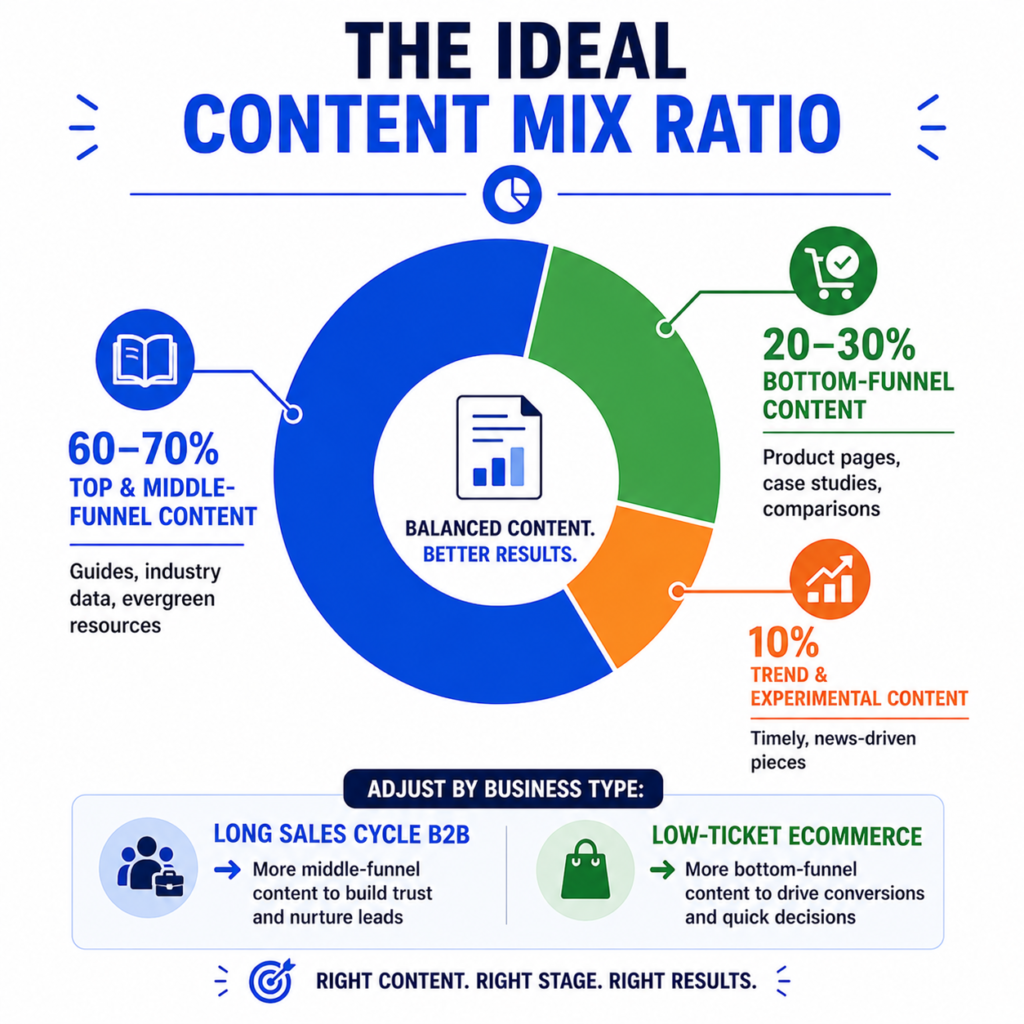
There’s no universal ratio that works for every business, but a reasonable starting point for most small-to-midsize companies looks something like this:
- 60-70% top and middle-funnel content – broad guides, industry data, comparison content that isn’t hard-branded yet, evergreen resources
- 20-30% bottom-funnel content – product pages, case studies, direct comparisons, pricing clarity
- 10% experimental or trend-driven content – timely pieces that capture attention around industry news or platform updates
This shifts depending on business model. A high-ticket B2B service with a long sales cycle usually needs more middle-funnel nurturing content relative to volume. A low-ticket ecommerce brand with impulse-purchase products can lean more heavily bottom-funnel, since the decision cycle is short and top-funnel education matters less.
One underused tactic: reviewing content you already have before writing more. A lot of “top-funnel” traffic that never converts isn’t actually a funnel problem – it’s a content-quality or staleness problem. Our guide on refreshing old blog posts is worth reading before assuming the fix is always new content. Organizing existing content into pillar and cluster pages also helps readers move naturally from top-funnel articles into more decision-focused ones without you having to force it.
Building this out doesn’t require a massive content team. It requires being honest about what stage each piece of content is written for, and resisting the urge to make every article try to close the sale. Explore more strategy breakdowns like this one on the QuickMarketingTools blog, or browse the full library of free marketing tools to support whichever stage of the funnel you’re working on next.
Frequently Asked Questions
Is top-funnel or bottom-funnel content more important?
Neither works well without the other. Bottom-funnel content converts the audience that top-funnel content builds. A business focused only on bottom-funnel content usually runs out of new people to sell to; a business focused only on top-funnel content builds an audience it never monetizes.
How do I know if a keyword is top-funnel or bottom-funnel?
Look at the phrasing. Broad, question-based, or definitional searches (“what is,” “how to,” “why does”) tend to be top-funnel. Comparative, branded, or transactional searches (“vs,” “pricing,” “best,” “for [specific use case]”) tend to be bottom-funnel. When it’s unclear, checking how Google currently ranks that term (blog posts vs product/category pages) is a reliable signal of the intent Google itself has assigned to it.
Can one piece of content serve both stages?
Rarely well. It’s possible to write a long-form guide with a top-funnel opening and a more direct, bottom-funnel section near the end (this article does exactly that), but trying to make an entire piece serve both an anonymous researcher and a ready-to-buy comparison shopper usually results in content that half-satisfies both instead of fully satisfying either.
How much content should be bottom-funnel?
Enough to answer every real objection a near-ready buyer would have: pricing, comparisons, proof, and a clear next step. For most businesses that’s a smaller volume of pages than top-funnel content, but it should never be treated as an afterthought, since it usually carries a disproportionate share of actual revenue relative to its traffic share.